
So we stopped saying “flattering"
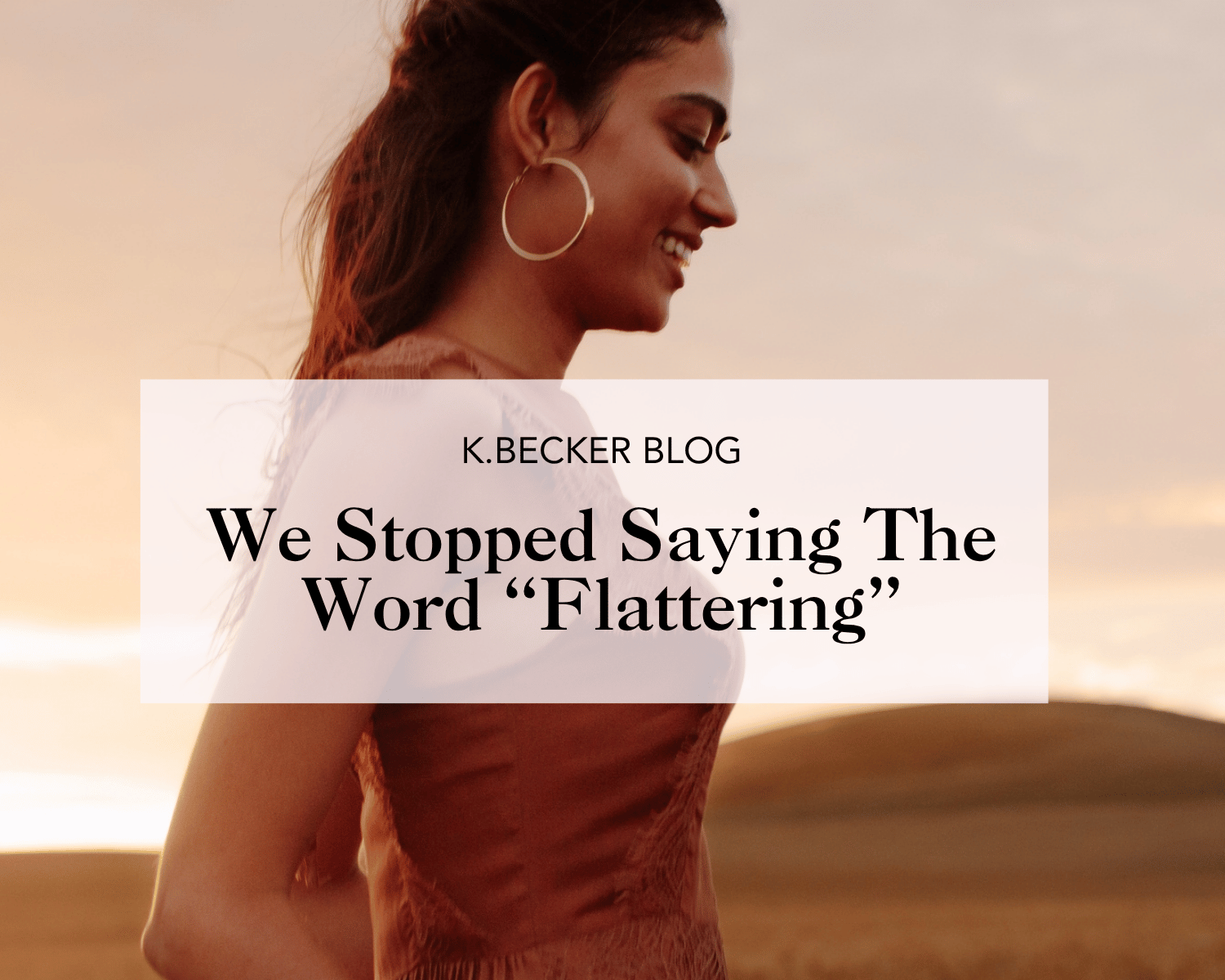
So we stopped saying “flattering
For years, “flattering” was one of those words I used without thinking much about it.
Does this dress flatter her?
Is that pant flattering?
What’s the most flattering shape for this body?
It’s part of the language of fashion. We all know what it means.
Or do we?
Because the more I design clothes, and the more time I spend fitting them on women, the more I’ve started to question what we’re actually saying when we call something “flattering.”
Flattering is about how you look to someone else.
Usually, it means a garment makes you look thinner. Or taller. Or hides your stomach. Minimizes your hips. Covers your arms. Creates the illusion of a different proportion.
In other words, flattering often starts with the assumption that there’s something about your body that needs to be managed.
I don’t want to design clothes that way.
I want to ask a different question.
When I’m working on a new piece, of course I care enormously about fit. I obsess over it.
I care where a jacket hits. How a pant falls from the hip. Where a waist sits. How much volume a skirt needs to move the way I want it to move. I will change a pattern over and over because a quarter of an inch can make a difference.
But the goal isn’t to make your body appear to be something it isn’t.
The goal is for you to put something on and think:
Damn. I look gorgeous.
Not thinner.
Not younger.
Not appropriately dressed for your age.
Not flattering.
Gorgeous.
And gorgeous is different.
Gorgeous can be a huge taffeta skirt that takes up some space.
It can be a pair of jeans with an unexpected shape.
It can be a sweater that doesn’t nip in at the waist or a jacket that isn’t designed to make you look smaller.
Sometimes the thing that makes you feel most fantastic is exactly the thing conventional fashion advice would tell you not to wear.
I know this firsthand. In my last post, I wrote about the dress I was convinced I shouldn’t wear—the one that broke all the little rules I’d accumulated over the years about what was and wasn’t “for” my body.
And then I put it on.
I felt fantastic.
Maybe some of those rules were never very useful in the first place.
I see this happen all the time.
A woman comes into my booth and immediately tells me what she can’t wear.
“I can’t wear that shape.”
“I can’t wear cropped.”
“I need to cover this.”
“My hips are too…”
“My stomach is…”
And then I convince her to try something anyway.
That moment after she gets dressed and looks in the mirror is one of my favorite parts of what I do.
Because sometimes she stands differently.
She walks out of the fitting room differently.
She isn’t examining whether the garment has successfully disguised some part of her body.
She’s looking at herself. And she likes what she sees.
That’s what I’m after.
I’m sure the word will occasionally slip out. I’ve been saying it for decades.
But it isn’t the standard I want to design toward anymore.
I want to make clothes you reach for first. The ones you’re happy to discover are clean. The pieces that make you want to walk into the room and own it. Clothes that turn heads without trying.
Most of all, I want to make clothes that shift the question from:
How do I look to them?
to:
How do I feel in this?
And I hope the answer is:
Gorgeous.
Every day of the week.
Comments